Step 01 / 06

Intent
User intent (in agent)
User asks the agent to find a product or service.
Agentic payments, agentic discovery: what do these terms mean in practice? This section defines them, explains how agents change the relationship between buyer, merchant, and payment, and lays out the stages in the shift from assistive AI to delegated spending.
Commerce has reinvented itself twice in twenty-five years, and each time the payment system had to be rebuilt to match.
Agentic is the third stage, and it is arriving faster than the infrastructure built for the first two can absorb. McKinsey projects agentic commerce could drive $3 trillion to $5 trillion in global consumer transactions by 2030, with up to $1 trillion in the US retail market alone.
2000s
Stage 1

2000s
Stage 1
Humans browse and click. Digital PSPs emerge.
2010s
Stage 2

2010s
Stage 2
Humans tap to pay. Wallets and tokenization arrive; the iPhone resets checkout.
Today
Stage 3

Today
Stage 3
Agents browse, compare, and advise. Consumers already use AI, but most purchases still complete on traditional flows.
At each stage, it was not only the interface for purchasing that changed. Both consumer behavior and the payment layer had to be re-engineered before the new model could scale. The companies that built the rails early set the terms for everyone who arrived later. Agentic is the stage still being defined, and the first live proofs are already here.
Agentic commerce only works if the whole payments industry moves together: AI platforms, card networks, banks, and merchants. No one company can build the connection between them alone.

Hilla Peled
SVP of Data Science and AI, Nuvei
"Agentic commerce," "AI-driven purchasing," and "LLM shopping discovery" are terms frequently used interchangeably across the industry, but they describe different things.
Agentic commerce is the medium through which consumers start making purchases. And it has two phases: the AI-led discovery phase, happening today and the agentic payment phase, which is still being built. One is about where decisions are made; the other is about how the money moves. Let's break them down.
Most of what is live today can be described as LLM-led discovery. On behalf of a consumer, an agent (ChatGPT, Perplexity, or Gemini) searches, compares options, and recommends. When the consumer decides, the agent hands the purchase back to them, and payment is completed on the merchant's own checkout as a standard transaction. The agent does the shopping but the human still pays.
Step 01 / 06
User intent (in agent)
User asks the agent to find a product or service.
Step 02 / 06
Agent discovery
Agent searches, compares, and recommends options.
Step 03 / 06
User decision
User selects a preferred option.
Step 04 / 06
Handoff to merchant
Agent redirects the user to the merchant website.
Step 05 / 06
Merchant-controlled checkout
User completes checkout on the merchant site.
Step 06 / 06
Traditional payment execution
Payment is processed as a standard eCommerce transaction.
01 / 06
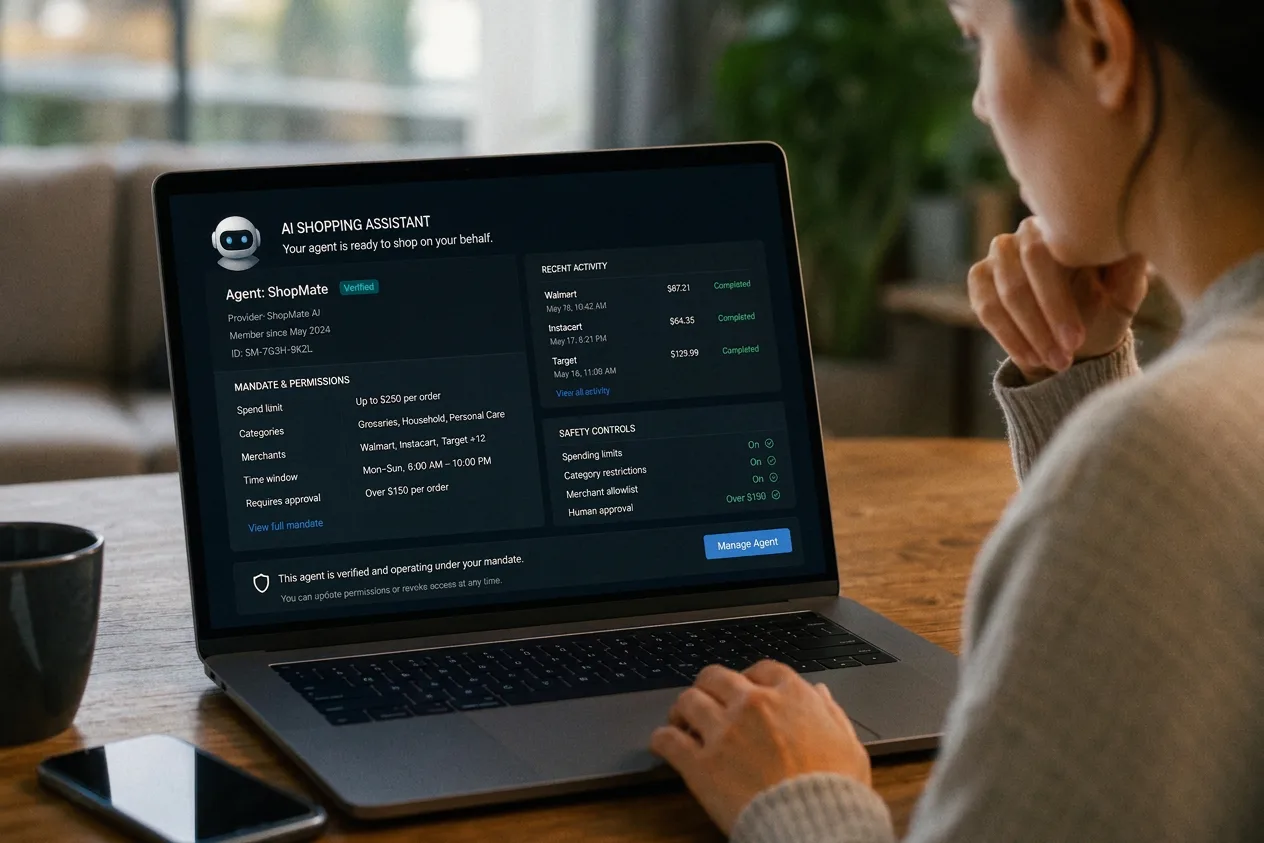
Agentic payments are the next step. The consumer sets a mandate in advance, say a limit of two hundred dollars on a defined task. The agent then initiates and completes the transaction itself, inside its own environment, with no redirect to a merchant checkout.
The point of initiating the payment moves from the human, the way it was done in the eCommerce world, to the machine.
In this phase of agentic commerce, discovery, authorization, and payment all happen inside the agent, with the agent initiating the transaction. That is the key shift, at step four: the payment stops being user-initiated and becomes agent-initiated instead.
Step 01 / 08
User intent (in agent)
User asks the agent to find a product or service.
Step 02 / 08
Agent discovery
Agent searches, compares, and recommends options.
Step 03 / 08
Mandate and authorization
User authorizes the agent to purchase on their behalf.
Step 04 / 08
Agent-triggered transaction
Agent initiates the transaction on behalf of the user.
Step 05 / 08
Trust and validation
Transaction is validated across multiple parties.
Step 06 / 08
In-agent payment processing
Payment is executed via a new transaction type.
Step 07 / 08
Merchant fulfillment and confirmation
Merchant receives the order and processes fulfillment.
Step 08 / 08
Confirmation in agent
User receives confirmation within the agent interface.
01 / 08
That shift - from a person initiating the payment in the AI-discovery and eCommerce stage to one where an agent makes the payment on the user's behalf - is where the current infrastructure has the biggest bottleneck.
For decades, the payments infrastructure relied on a human at every stage of the purchase. A transaction with no human at the checkout has to carry trust in two directions at once: trust in the consumer, validated as it is today via KYC, and trust in the agent acting for them, validated via new protocols, such as Know Your Agent.
As Mentxu Trivino, VP of Payments Partnership at Nuvei puts it:
The question is no longer whether a payment can be processed. It is who, or what, is authorizing it, what that actor is allowed to do, and who is liable when something goes wrong.
This next era of agentic commerce requires a different infrastructure and different rules of governance, making sure the agent initiating the payment is verified, trustworthy, and carries the credible user intent. This is exactly where Nuvei is building.
There is a second distinction that decides how merchants meet this shift. A first-party agent is one a merchant runs itself, inside its own site, app, and customer relationship. A third-party agent is a public assistant like ChatGPT or Gemini that acts across many merchants at once. The two raise different trust questions, and the merchants Nuvei works with are clear that they will meet the first-party version first. That ordering shapes everything Nuvei is building.
But before we get into that, let's see what consumers have to say about how they use AI when making purchases.
BLOG
As AI agents start shopping and paying on behalf of consumers, Know Your Agent becomes the new trust layer in payments. How PSPs and acquirers can govern agent identity, mandates, and local execution.
Read more